MCO
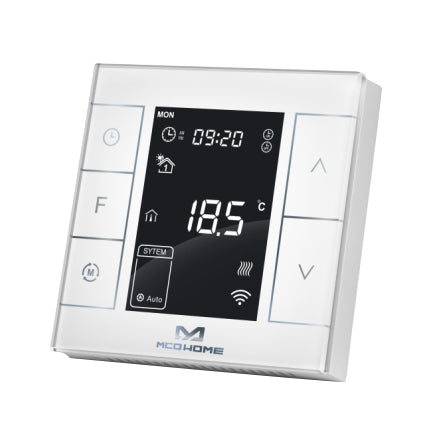
MCO Home Electrical Heating Thermostat with humidity sensor Version 2
MCO Home Electrical Heating Thermostat with humidity sensor Version 2
Couldn't load pickup availability
The MCO Home Electrical Heating Thermostat with Humidity Sensor, Version 2 (model likely MH7H-EH2 for the Electrical Heating version), is an advanced, Z-Wave Plus smart thermostat designed to control various electrical heating systems.
Here are the key features and specifications:
Functionalities:
-
Application: Primarily for controlling electrical heating systems, such as:
-
Heating cables (electric underfloor heating).
-
Electro-thermal films.
-
Electric radiators/heating actuators.
-
-
Z-Wave Plus: Utilizes Z-Wave Plus (often referred to as Gen 5) for integration into a smart home network.
-
Design: Features a modern aesthetic with a tempered glass panel and capacitive touch buttons.
-
Installation: Requires a permanent mains power supply (AC85-260V) and is designed for flush-mount installation in European wall boxes.
Sensing and Control:
-
Dual Sensing: Includes a built-in room temperature sensor and a humidity sensor.
-
External Sensor: Supports an optional external NTC temperature sensor (e.g., for floor temperature limit) with a high-temperature protection function (cuts off heating if floor temperature exceeds 55∘C).
-
Control Modes: Supports:
-
Manual Mode
-
Auto Mode (programmable time periods)
-
Holiday/Energy Saving Mode
-
-
Programmable Schedule: Allows for a weekly schedule with 4 events (time periods) each day (7-day or 5+2 / 5+1+1 options).
Technical Specifications (MH7H-EH):
-
Power Supply: AC85-260V, 50/60Hz.
-
Max Output: ≤16A (for Electrical Heating model).
-
Self-Consumption: ≤1W.
-
Temperature Setting Range: 5∘C to 37∘C (41∘F to 99∘F).
-
Sensors: Internal NTC 15K, External NTC R25$^\circ C$=15K$\Omega$.
Version 2 Enhancement:
-
The key feature of Version 2 (V2) is enhanced Z-Wave capability, specifically the ability to use Association Groups to directly control other Z-Wave binary switch actors (like plugs and relays) without requiring a constant command from the central Z-Wave gateway. This makes it more resilient and versatile in controlling various heating components.
Share